Get this book

Amazon
Books & Kindle

Audible
Audiobook

Bookshop.org
Support indie stores
Affiliate links — I earn a small commission if you buy, at no extra cost to you. Learn more
Data via openlibrary
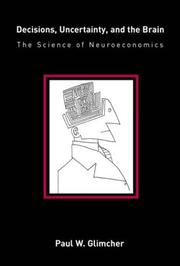
Decisions, Uncertainty, and the Brain
No ratings yet
In this work, Paul Glimcher argues that economic theory may provide an alternative to the classical Cartesian model of the brain and behavior. Ren Descartes (1596-1650) believed that all behaviors could be divided into two categories, the simple and the complex. Simple behaviors were those in which a given sensory event gave rise deterministically to an appropriate motor response. Complex behaviors were those in which the relationship between stimulus and response was unpredictable. These behaviors were the product of a process that Descartes called the soul, but that a modern scientist might call cognition or volition. Glimcher argues that Cartesian dualism operates from the false premise that the reflex is able to describe behavior in the real world that animals inhabit. A mathematically rich cognitive theory, he claims, could solve the most difficult problems that any environment could present, eliminating the need for dualism by eliminating the need for a reflex theory. Such a mathematically rigorous description of the neural processes that connect sensation and action, he explains, will have its roots in microeconomic theory. Economic theory allows physiologists to define both the optimal course of action that an animal might select and a mathematical route by which that optimal solution can be derived. Glimcher outlines what an economics-based cognitive model might look like and how one would begin to test it empirically. Along the way, he presents a fascinating history of neuroscience. He also discusses related questions about determinism, free will, and the stochastic nature of complex behavior.
Get this book
Amazon
Books & Kindle
Audible
Audiobook
Bookshop.org
Support indie stores
Affiliate links — I earn a small commission if you buy, at no extra cost to you. Learn more