
Get this book

Amazon
Books & Kindle

Audible
Audiobook

Bookshop.org
Support indie stores
Affiliate links — I earn a small commission if you buy, at no extra cost to you. Learn more
Data via openlibrary
Ethics in Ancient Greek Literature
No ratings yet
Interpretation of ancient Greek literature is often enough distorted by the preconceptions of modern times, especially on ancient morality. This is often equivalent to begging the question. If we think e.g. of aretê, which has different meanings in different contexts, we shall think in English (or in Modern Greek or in French or in German) and shall falsify the phenomena. If we are to understand the Greek concept e.g. of aretê we must study the nature of the situations in which it is applied. For it is an important fact in the study of Greek society that the Greeks used the one word (e.g. aretê) where we use different words. If we are to understand properly the texts, we have to view them in their historical and social context. Ancient Greek thought needs to be studied together with politics, ethics, and economic behaviour. Moreover, the best insights can be found in those who confine themselves to the terms of each ancient author's analysis. From this principle each of the contributions of the volume begins.
Get this book
Amazon
Books & Kindle
Audible
Audiobook
Bookshop.org
Support indie stores
Affiliate links — I earn a small commission if you buy, at no extra cost to you. Learn more
Creators
More like this
The form and function of sayings-material in Hellenistic biographies of philosophers
1985
Les trois fonctions indo-européennes en Grèce ancienne
1998

Sabiduria simbolica y enigmatica en la literatura Grecolatina
2011
Anecdota cantabrigiensia
1896
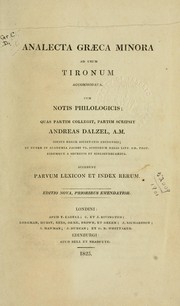
Analecta graeca minora ad usum Tironum
1825
Histoire de la pensée nord-africaine
2016