Get this book

Amazon
Books & Kindle

Audible
Audiobook

Bookshop.org
Support indie stores
Affiliate links — I earn a small commission if you buy, at no extra cost to you. Learn more
Data via openlibrary
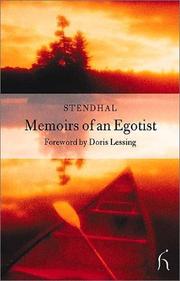
Memoirs of an egoist
No ratings yet
Written in 1832, three years before The Life of Henry Brulard (which recounts the author?s boyhood and youth), Memoirs of Egotism forms the essential middle section of Stendhal?s intended autobiography. Along with Journals of Italy, these volumes comprise what Andr Gide has called one of the truly great autobiographies in any language. Unpublished until fifty years after the Stendhal?s death, Memoirs of Egotism concerns itself exclusively with the decade following his return from Milan to Paris in 1821. Stendhal appears as a cynical wit, adventurer, lover, brilliant conversationalist, and secret man of letters. We are privy to his encounters in the salons and boudoirs of the capital, with his attendant hopes (realized and disappointed), private foibles, and social miscalculations. Stendhal?s passionate and ceaseless pursuit of happiness is on display, intertwined, as always, with the undercutting wit and unsparing self-analysis that have transformed his name into an adjective for an entire point of view?all as frankly conveyed and keenly observed as in any memoir before or since. The book is deftly translated by Hannah and Matthew Josephson. Mr. Josephson also provides an extensive introduction and editorial notes. ______?The lens of his intelligence is focused on himself with a concentration that amounts to ferocity.??Doris Lessing?He had the faculty of surrendering himself to some emotional experience, then recording it afterward with complete self-consciousness. He tried to examine himself, and others, with the experimental and dispassionate attitude typified by the new scientists of the time, much as his friend Cuvier, the biologist, dissected animals in his laboratory?eschewing bombast, or sentiment.??from the editor?s introduction.
Get this book
Amazon
Books & Kindle
Audible
Audiobook
Bookshop.org
Support indie stores
Affiliate links — I earn a small commission if you buy, at no extra cost to you. Learn more