Get this book

Amazon
Books & Kindle

Audible
Audiobook

Bookshop.org
Support indie stores
Affiliate links — I earn a small commission if you buy, at no extra cost to you. Learn more
Data via openlibrary
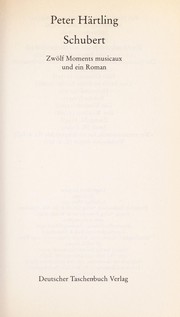
Schubert
No ratings yet
Brilliant, soulful, poor, and doomed to a short life, Franz Peter Schubert (1797-1828) in many ways embodied the Romantic era in which he lived. In this vibrant biographical novel, Peter Hartling brings the composer to life as a man of exquisite sensitivity, passionate extremes, and a profound sense of rootlessness much like the famous wanderers of his musical creations. The deftly interwoven description and dialogue recreate Schubert's family, education, friendships, loves, and the exciting milieu of Vienna during the Napoleonic era, where Schubert was introduced to the many works of his contemporaries, including Beethoven, Rossini, Salieri, Schiller, and Goethe. Interspersed throughout the story are twelve vignettes, or "musical moments," each capturing a particular stage in Schubert's brief life. The young composer worked at a feverish pace, setting words to music in minutes, and the number of beautiful pieces he could produce in a single day astonished even musically sophisticated Vienna. Many compositions were of unparalleled emotional intensity, including the Trout Quintet, "Great" C Major Symphony, Wanderer fantasy, and Winterreise. As his circle of admirers in Vienna gradually widened, he was often asked to play the piano and to sing at Schubertiads, special evenings devoted to his music, which might begin as informal concerts and end with dancing. But these gatherings were isolated moments of gaiety in Schubert's otherwise tragic life. Although romantic love is a major theme in many of Schubert's works, and he clearly enjoyed the company of women, his two great loves were never realized. He first fell in love with a soprano named Therese Grob and, later, with his student, the young countess Karoline Esterhazy, whom he dared not even approach. Instead the socially awkward, self-conscious musician resigned himself to one or more loveless affairs. The novel closes as it opens - with a poignant dream sequence in which the narrator finds himself among Schubert's friends, intently listening as their friend Franz plays the piano.
Get this book
Amazon
Books & Kindle
Audible
Audiobook
Bookshop.org
Support indie stores
Affiliate links — I earn a small commission if you buy, at no extra cost to you. Learn more