Get this book

Amazon
Books & Kindle

Audible
Audiobook

Bookshop.org
Support indie stores
Affiliate links — I earn a small commission if you buy, at no extra cost to you. Learn more
Data via openlibrary
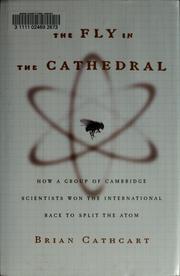
The Fly in the Cathedral
No ratings yet
***Amazon.com Review*** If you want to understand how something works, you can dismantle it and study its pieces. But what if the thing you're curious about is too small to see, even with the most powerful microscope? Brian Cathcart's The Fly in the Cathedral tells the intriguing story of how scientists were able to take atoms apart to reveal the secrets of their structures. To keep the story gripping, Cathcart focuses on a time (1932, the annus mirabilis of British physics), a place (Cambridge's Cavendish Laboratory), and a few main characters (Ernest Rutherford, the "father of nuclear physics," and his protégés, John Cockcroft and Ernest Walton). Rutherford and his team knew that the long-accepted atomic model was held together by nothing more than trumped-up math and hope. They hoped to find out what held oppositely charged protons and electrons together, and what strange particles shared the nucleus with protons. In a series of remarkable experiments done on homemade apparatus, these Cambridge scientists moved atomic science to within an inch of its ultimate goal. Finally, Cockcroft and Walton--competing furiously with their American and German peers--put together the machine that would forever change history by splitting an atom. The Fly in the Cathedral combines all the right elements for a great science history: historical context, gritty detail, wrenching failure, and of course, glorious victory. Although the miracles that occurred at Cambridge in 1932 were to result in the fearful, looming threat of atomic warfare, Cathcart allows readers to find unfiltered joy in the accomplishments of a few brilliant, ingenious scientists. --Therese Littleton
Get this book
Amazon
Books & Kindle
Audible
Audiobook
Bookshop.org
Support indie stores
Affiliate links — I earn a small commission if you buy, at no extra cost to you. Learn more